
Articles · Comparison
Pavers vs. Concrete
Driveways in Florida
By Augusto Lodos, Owner & Executive Commercial Director · August 20, 2026
Most comparisons like this are written by someone who installs one of the two and needs the other to lose. We install both — concrete where it's the right call, pavers everywhere else — so here's the version we actually give people standing in their driveway. It comes down to failure mode: concrete fails all at once, pavers fail one unit at a time. In Central Florida's shifting soil, that difference is the whole decision.
The Comparison Nobody Makes Honestly
Search this question and you'll mostly find contractors who install one of them explaining why the other is a mistake.
We install both. We lay concrete on commercial sites where it's the right call, and we've removed more failed residential slabs than we can count. So here's the version we give people standing in their driveway, which is less tidy than either sales pitch.
Concrete is cheaper to put down. Pavers deal with Florida better. Whether that trade is worth it depends on how long you're staying and what your ground is doing.
Why Florida Changes the Answer
Most comparisons of this kind are written for a national audience, and they lead with freeze-thaw damage — water getting into the surface, freezing, expanding, breaking it apart. That's the main reason concrete fails in most of the country.
It's almost irrelevant here. What matters in Central Florida is different:
- The soil is light and sandy, and it moves. Not dramatically, not all at once, but continuously. Anything rigid sitting on top of it is in a slow argument with the ground.
- Rain arrives faster than the ground takes it. Two inches in an afternoon has to go somewhere, and a sealed surface decides where — usually toward your foundation.
- Heat is constant and direct. Surface temperature decides whether a pool deck gets used in July or walked across quickly.
- Humidity and shade grow algae on anything porous that stays damp.
Freeze-thaw isn't your problem. Ground movement and water are.
How Each One Fails
This is the part that actually separates them, and it's about failure mode rather than durability. Both are strong. They just behave completely differently when the ground underneath shifts.
Concrete is one piece. That's its structural advantage and its terminal weakness. When the soil moves under a slab, the slab has no way to accommodate it, so it cracks. Once it cracks, the crack grows — water gets in, the edges lift, and the repair options are bad. You can fill it, which is visible and temporary. Or you remove the entire slab and start again, because you cannot replace the cracked part of a monolithic pour.
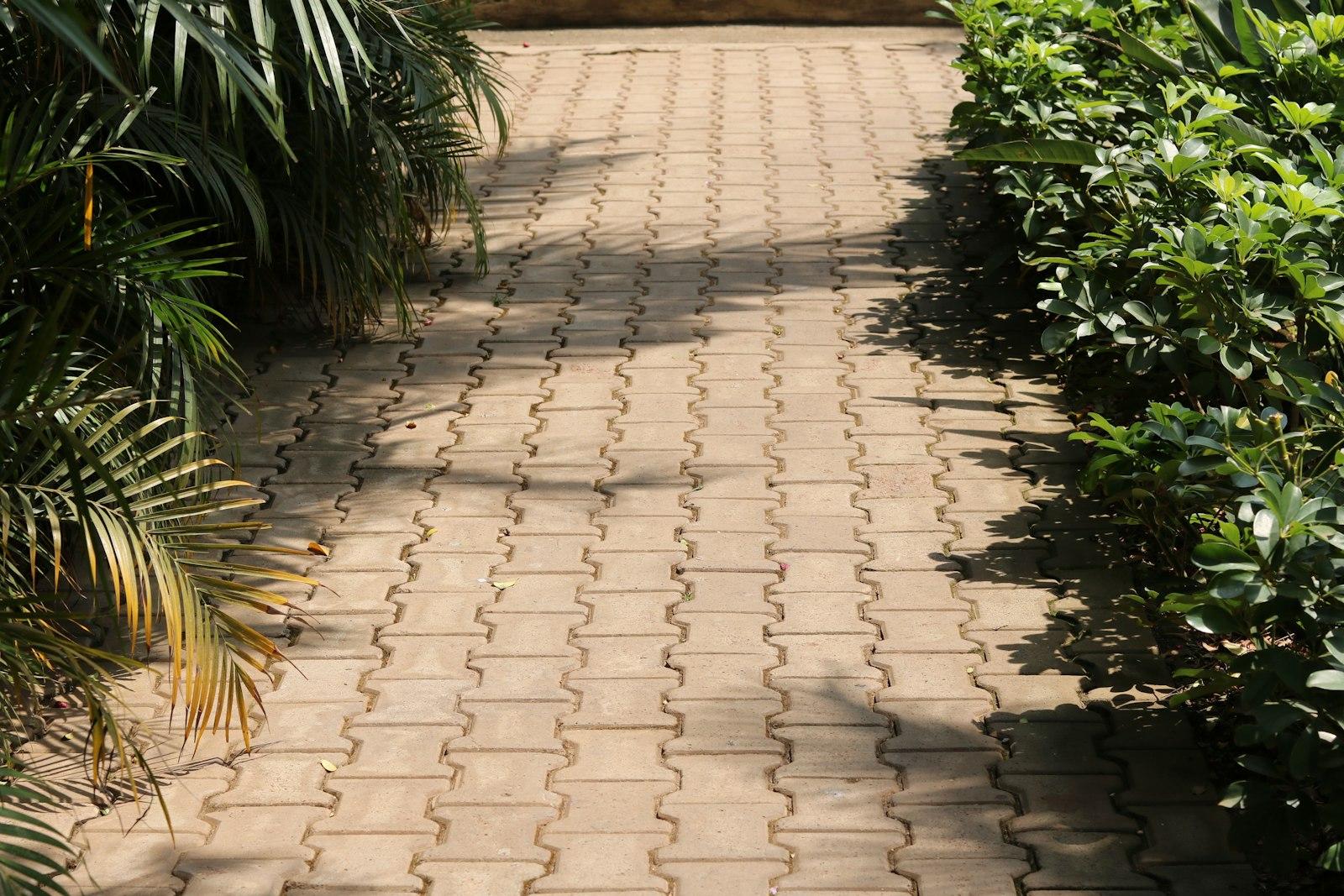
Pavers are hundreds of pieces. Ground movement shows up as a settle rather than a fracture. A dipped section gets lifted, the base beneath it corrected, and the same units reset — no seam, no colour mismatch, no evidence. If a unit is stained or damaged, it comes out individually.
That's the whole comparison in one line: concrete fails all at once and pavers fail one unit at a time.
Water
Concrete sheds water. Every drop that lands on a slab runs to its edge, which means you've concentrated your drainage problem rather than solved it — and in a Florida storm season, the edge of a driveway is often close to a foundation.
Pavers have joints. Water passes between units into the base and disperses, and where drainage is a real concern the system can be built permeable so it handles volume deliberately.
On a graded site this stops being a preference. In Clermont, where the hills mean water always goes somewhere, it decides the specification.
Heat, Colour and How They Age
Concrete holds heat and it holds stains. It also fades unevenly — the surface greys, and any colour or stamping applied to it fades faster than the substrate.
Pavers hold colour because in most cases the colour is through the unit rather than on it. And around water, material choice gives you a genuine temperature difference — travertine stays notably cooler underfoot than a poured slab in full sun, which is why it's the default on pool decks around Dr. Phillips and Windermere.
Stamped concrete deserves a specific mention because it's often pitched as the middle option. It gives you the look of pavers at closer to concrete cost. It also gives you concrete's failure mode plus a surface treatment that wears — when it cracks, and it does, the pattern makes the repair more visible rather than less.
The Cost Conversation
Concrete costs less to install. That's the honest starting point and the reason it's specified as often as it is.
What we won't do is give you a tidy percentage for the difference, because it isn't tidy — it swings on area, access, material grade, and what's already on the ground. Anyone quoting you a clean figure for "pavers cost X% more" is estimating, whatever they call it.
What we can tell you is where the money actually goes over time:
- A concrete slab that cracks needs full removal and replacement, not a repair
- A paver section that settles gets lifted and reset at a fraction of that
- Sealing costs apply to both, but a stained paver can be swapped and a stained slab can't
- The base work underneath is the same either way — and it's the part that decides whether either surface lasts
Our published ranges for paver work are on the driveways and patios pages, and we'll give you an itemised written quote within 24 hours of seeing the site. If concrete is genuinely the better answer for what you're doing, we'll say so.
The Part That Matters More Than Either
You can install both of these badly, and in this market both frequently are.
Central Florida's light soil won't support a surface laid straight onto it. Every job we do gets a 4" concrete base, levelled and compacted, before anything goes on top. That's true for pavers and it's true for a slab. It's the slowest part of the work and the first thing cut when a quote needs to look competitive.
A well-installed concrete driveway will outlast a badly installed paver driveway comfortably. The material argument only starts once the base is right — which is why, when you're comparing quotes, the base spec tells you more than the material does.
So Which One
Rough guide, and we'd rather give you this than a recommendation that happens to suit us:
- Concrete makes sense if you're optimising for lowest cost now, the site is flat and drains well, and the surface is functional rather than presentational.
- Pavers make sense if the surface is part of how the property presents, you're staying long enough for the repair economics to matter, the site has grade or drainage to manage, or you'd like to not resurface the whole thing when one section moves.
One thing we won't do is lay pavers over a cracked existing slab. The movement that cracked it is still there, and it'll come through your new surface within a couple of summers. We'll quote the removal and a proper base, or we'll pass on the job.
Tell us what you've got and what you want it to do. We'll come out, look at the ground, and give you a straight answer — including if that answer is concrete.
More Articles
May 16, 2026
Top Pavers for Florida Homeowners: A Complete Guide
A complete guide to choosing the right paver material for Florida's demanding climate — from travertine and concrete to porcelain and natural stone.
May 16, 2026
Why Paving Is the Go-To Choice in Central Florida
How high-quality paving systems deliver durability, elegance, and long-term property value for residential and commercial properties across Florida.
May 16, 2026
The History of Paving in Florida: From Brick Streets to Modern Luxury Hardscapes
From St. Augustine's historic brick streets to Central Florida's modern luxury hardscapes — how Florida's paving tradition evolved over a century.
Get Started
Ready to transform your
outdoor space?
We visit your property, assess what's needed, and give you a full written quote within 24 hours. No pressure.